MSX
The MSX home computer architecture was initially developed at Microsoft (June 16, 1983) by Kazuhiko Nishi of Microsoft Japan.
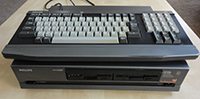
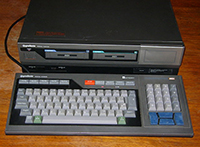
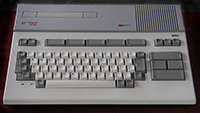
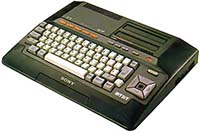
It was not until recently that I was given an MSX machine made by Gradiente in Brazil (Gradiente Expert). It seems you can still build your own MSX computer, the GR8BIT. MSX means Machines with Software eXchangeability. Late in 1985, the MSX2 was born.
History
The Spectravideo SV-328 was the prototype for the MSX design, but small differences between them made the 318/328 incompatible with MSX. The differences included the BIOS, the I/O ports, and the disk format.
From the 8-Bit Museum's MSX web page, celebrating 35 years of MSX on June 16, 2018:
“35 years ago, on June 16, 1983, Microsoft mentioned for the first time the home computer standard MSX. Devised was this by Kazuhiko Nishi, then vice president of Microsoft Japan and founder of ASCII Corporation... As an open standard MSX was implemented by many Japanese and Korean companies such as Sony or Sanyo. In Europe, Philips has pioneered its own MSX computers. The operating system is Microsoft BASIC was used, from which the name derives MSX (“Microsoft BASIC eXtended”). In Japan or the Netherlands MSX was temporarily a leader, even before that time very popular C64. The standard has evolved over the years: MSX 1 (1983), MSX 2 (1985), MSX 2+ (1988) and MSX turbo R (1990/1992). In the United States was MSX no success despite the efforts of Microsoft. Overall, however, more than 5 million units to be sold in Japan alone and thus was MSX, before the great success of the Nintendo Family Computer, the main platform for Japanese video game companies like Konami and Hudson Soft. Known titles such as Metal Gear series were originally written for MSX devices. In this video, Bill Gates, Kazuhiko Nishi and Sir Clive Sinclair express their opinion on MSX. Also mentioned are still the C64, Dragon 32 and Apple IIc.”8-Bit Museum (translated from German)
Emulators and software
Emulators. MSX emulators for the PC include blueMSX and openMSX. For a Java-based emulator, there was JaMSX (Firefox only).
JaMSX is a Java applet, and no current browser runs Java applets any more. blueMSX and openMSX are desktop programs and still work.
Museums
In June 2013, Tony Smith wrote a nice history of the MSX:
“Microsoft formally announced the MSX platform on 16 June 1983. Eleven days later, Canon, Fujitsu, Hitachi, JVC, Mitsubishi, National, Sanyo, Sony, Toshiba, Yamaha and other Japanese firms, plus Korea’s Goldstar – now LG – and US-Hong Kong company Spectravideo announced they would support the new would-be standard. Most would ship kit in Japan well before the year was out. But the origins of MSX go back two years before that, to 1981 and the August launch of the IBM PC, aka the 5150.
Existing and current home machines contained 8-bit processors, but the IBM 5150’s Intel 8088 processor was a 16-bit part. Even though the 5150 had been designed for business users, it was seen by many observers as the beginning of the end of the era of 8-bit microcomputing, established in the mid-1970s.”Tony Smith, The Register, June 2013
The 8-Bit Museum in Germany maintains a long list of 8-bit computers, including the MSX. The Video Game Museum (VGMuseum.com) also has a list (no downloads) of many games for the MSX.
